Professional Alcohol Counselling in Scotland
Scotland's alcohol and drug system has changed a great deal in recent years. Integrated pathways, Alcohol and Drug Partnerships and recovery-oriented systems of care have brought many benefits, but they have also raised a question SACC could not answer with confidence: what specifically does alcohol counselling contribute and would that contribution be missed if it became less distinct within broader services?
National strategy and routine data give us activity figures and treatment statistics, but they tell us very little about why people choose counselling, what makes it feel usable, what changes it supports and what would be lost without it.
SACC commissioned this evaluation from Figure 8 Consultancy Ltd to close that gap, using evidence directly from our member services, our clients and the professionals who deliver this work.
We wanted evidence we could stand behind, learn from and that would allow us to be clear about what we are asking commissioners, referrers and partners to protect.
Key Findings:
Alcohol counselling reaches people who may not otherwise access help, creates the conditions for safe therapeutic work, supports client-led change and contributes to outcomes beyond drinking status.
Alcohol counselling is a professional therapeutic intervention.
Alcohol counselling is complementary to, not interchangeable with, other supports.
The value of alcohol counselling lies in supporting meaningful, client-defined change across a continuum of goals. It should not be assessed through an abstinence-only lens.
Drinking-related change is central to alcohol counselling.
Alcohol counselling provides wider benefits (confidence, health, purpose, social connection) which are not secondary and should be reflected in how services are valued, commissioned, and measured.
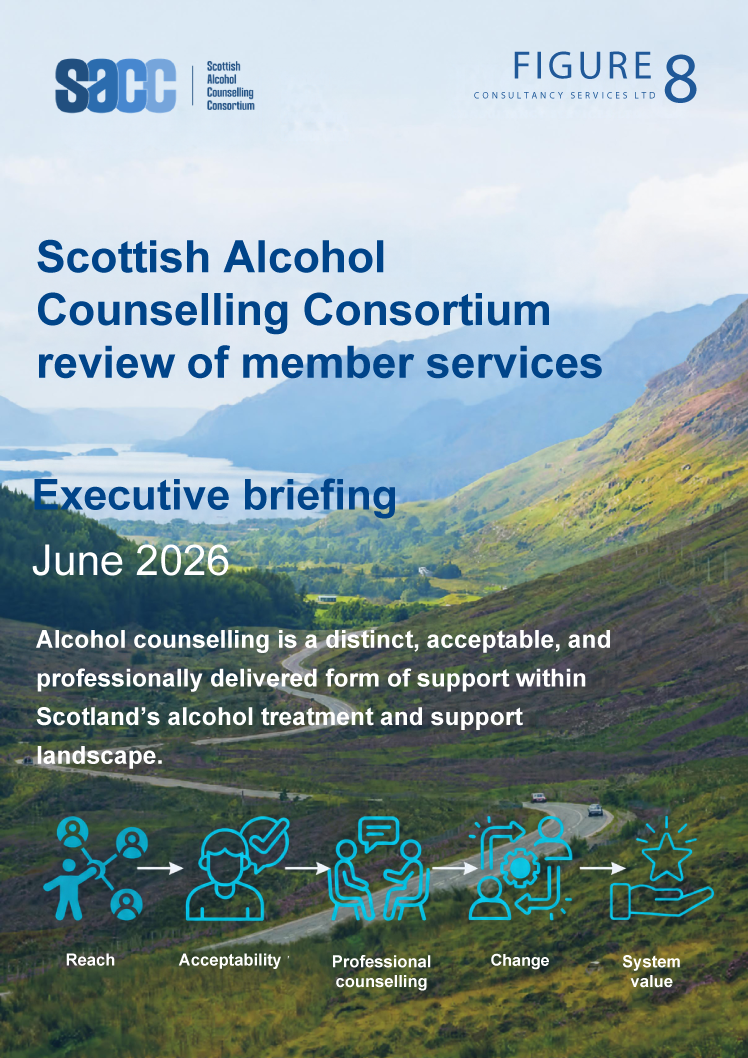
Click the images below to download the reports.
A five-part action agenda for alcohol counselling:
Protect recognisable alcohol counselling route
Maintain confidential, alcohol focused counselling with direct access, and clear one-to-one support.

Specify professional counselling standards
Recognise trained counsellors, clinical supervision, ethical practice, confidentiality, therapeutic boundaries and safe containment.

Retain flexible client-led goals
Support abstinence where chosen, alongside reduction, moderation, harm reduction, relapse prevention and wider wellbeing.

Evidence shared minimum outcomes framework
Use a small consistent dataset that captures drinking-related change, wellbeing, relationships, family change and client-defined progress.

Research economic and system impact
Strengthen the evidence base on longer-term outcomes, prevention, avoided escalation, and cost-consequences value.

Join one of our dissemination sessions
To hear more about this research and add your voice to a discussion with SACC leadership and Josh Dumbrell from Figure 8 Consultancy Ltd, RSVP one of our sessions being held on Wednesday 25th and Friday 27th November.

Take out the counselling and just do the medication from the ADRS, go through to AA and not ever, ever… offload your feelings or what’s going on for you and how you’ve came to where you are that day… I think would be detrimental to so many different lives.

I knew that at that point abstinence was what I needed to do, but I knew that the abstinence would only come on the back of dealing with the mental health issues because it was the mental health issues that were triggering my drinking. It wasn't the other way around.
I had previously started as a counselling client due to my own alcohol issues. That was a few years ago now that I was a client and then I moved on from that to working with that service, that charity.
I personally just love the one-to-ones, like group stuff and that don't really work for me. Having that option as well, like, if you can't do the group work, the one-to-ones there, that always kept me coming back.
I would just like a wee bit of praise for where I go to the counselling. And I would like you to thank every one of them that's in it for helping me because I don't know where I would be without them, each and every one of them in that building.